RSS
aibo-europe.com
July 13, 2026
Uncategorized

chocolate con churros Archives – Eva Milano

maximios
0 0 3
Share

Spain bridges Europe and Africa, the Mediterranean Sea and the Atlantic Ocean. The territory of the country has been under the influence of many different cultures, each of them adding something to the traditional Spanish cuisine. Olives, oil and wine are a Roman heritage, cooking meat and fish is a Celtic one, the Arabs introduced honey, almonds, citrus fruits and spices like cumin and saffron. Spanish expeditions during the Age of Discovery brought various products from the New World – tomatoes, potatoes, corn, peppers and chocolate. Gradually these foods become a permanent part of Spanish dishes. Modern Spanish cuisine is delicious and diverse. But there are a few traditional courses that you absolutely need to taste.

Paella in Valencia

Paella Valenciana, Spanish cuisine

A popular urban myth claims that the Valencian mix of rice, vegetables, meat and seafood was created by a man who wanted to surprise his loved one with a home-made dinner. When he came back home, he realised that he had only leftovers. He quickly mixed all that he had in the fridge and presented the new dish to his lady. That is how the name paella was born: coming from the Spanish “para ella” that translates as “for her”.

The true story about how paella was born is not even remotely as romantic. The food was popular among servants who brought home the leftovers from the exquisite banquets of Moorish kings. The name comes from the Latin word for the pans in which paella was cooked.

Paella has a number of variations, depending on which region you are visiting. It could be vegetarian or served with meat and seafood. The key to the savoury taste of this dish lies in the use of onion and saffron.  Regardless of which type of paella you get to try, you will most definitely be impressed.

Tortilla in Pamplona

Tortilla de patatas, Spanish cuisine

Every year Pamplona attracts a number of visitors for the famous festival of San Fermín.  The celebration is known for the run of six fierce bulls down the cobbled streets of the town. The festival is very popular but far less beloved than the delicious tortilla de patatas of Pamplona.

This dish was used during the 19th century as a simple, cheap and easy way to feed the Spanish army. The potato omelet is a staple in most bars around the country. Some world-class chefs have developed their own recipes inspired by Spanish tortilla. The original, however, is still a classic that you should not miss.

Gazpacho in Andalucia

Gazpacho andaluz, Spanish cuisine

Gazpacho is a cold tomato soup from Andalucia, the most southern region of Spain. Firstly, the cream soup was made with bread, olive oil, vinegar and garlic. In the different places the dish had variations including local vegetables or almonds. When Columbus brought tomatoes, cucumbers and peppers from his travels, the recipe got modified to what we know today.

A popular Spanish refrain says “You can never have too much gazpacho”. Taste this refreshing soup and you will surely agree!

Pintxos in the Basque country

Pintxos, San Sebastian, Spanish cuisine

You have probably heard of tapas – food bites that usually “accompany” your beer n typical Spanish bars. In the past people used a piece of bread topped with hamón to protect their drink from dust and insects. Nowadays tapas are not so practical but a lot more diversified and surprisingly appetizing.

What are pintxos? Well, more or less the same as tapas just better because they are made in the Basque country in the North of Spain. This region boasts with flavourful food thanks to the high quality products that are produced locally. San Sebastian is one of the most touristic places in this part of the country. The city is literally laden with pintxos bars, each one of them offering a vertiginous range of tastes.

Chocolate con churros in Madrid
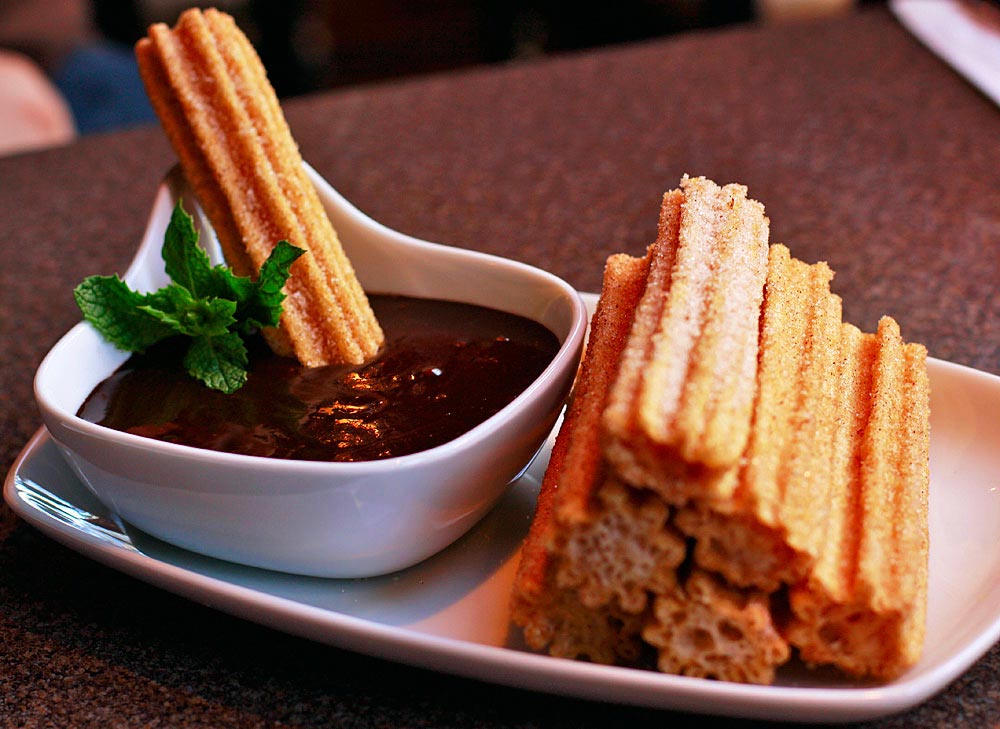
Chocolate con churros, Spanish cuisine

Photo by Waferboard on Flickr, Curves correction by me

For dessert I want to offer you one of those sugarcoated temptations that are not to everyone’s taste but are still a must-try. Fried sweet bread served with hot chocolate is one of the most common breakfast meals in Spain, especially in Madrid. The origin of churros is a culinary mystery. Some claim that the recipe was brought to the Iberian Peninsula by the Portuguese who travelled to Asia. There is a similar food in the North of China known as “youtiao”. Others say that churros were first made by shepherds who wanted to prepare something indulgent and easy. The authenticity of this version is supported by the existence of a sheep breed Churra.

Churros and chocolate were first combined in the 19thcentury and haven’t stopped to impress foodies ever since. To my taste street churros are too greasy and not sweet enough. But the home-made bread sticks rolled in brown sugar and cinnamon are a whole another thing. Nevertheless, I am yet to meet someone else who has not fallen in love with churros from the first taste. That is why it is imperative to try them. To top it all, churros in Latin America are filled with chocolate, dulce de leche, cheese or even guava!

Spanish cuisine is colourful and diversified. You should seriously consider a gastronomic trip through all 17 regions of the country. Each one offers dishes to impress. If you love good food, check out my list of the best from Italian cuisine.

Follow:

You may also enjoy:

  • Spanish tortilla – simple and tasty

    Spanish tortilla – simple and tasty

  • Vegan breakfast smoothie: Spinach delight

    Vegan breakfast smoothie: Spinach delight

  • Pizza Margherita with einkorn flour

    Pizza Margherita with einkorn flour

  • Three Spanish recipes with tomato

    Three Spanish recipes with tomato

July 13, 2026
Uncategorized

5 outstanding dishes from Spanish cuisine

maximios
0 0 4
Share

Spain bridges Europe and Africa, the Mediterranean Sea and the Atlantic Ocean. The territory of the country has been under the influence of many different cultures, each of them adding something to the traditional Spanish cuisine. Olives, oil and wine are a Roman heritage, cooking meat and fish is a Celtic one, the Arabs introduced honey, almonds, citrus fruits and spices like cumin and saffron. Spanish expeditions during the Age of Discovery brought various products from the New World – tomatoes, potatoes, corn, peppers and chocolate. Gradually these foods become a permanent part of Spanish dishes. Modern Spanish cuisine is delicious and diverse. But there are a few traditional courses that you absolutely need to taste.

Paella in Valencia

Paella Valenciana, Spanish cuisine

A popular urban myth claims that the Valencian mix of rice, vegetables, meat and seafood was created by a man who wanted to surprise his loved one with a home-made dinner. When he came back home, he realised that he had only leftovers. He quickly mixed all that he had in the fridge and presented the new dish to his lady. That is how the name paella was born: coming from the Spanish “para ella” that translates as “for her”.

The true story about how paella was born is not even remotely as romantic. The food was popular among servants who brought home the leftovers from the exquisite banquets of Moorish kings. The name comes from the Latin word for the pans in which paella was cooked.

Paella has a number of variations, depending on which region you are visiting. It could be vegetarian or served with meat and seafood. The key to the savoury taste of this dish lies in the use of onion and saffron.  Regardless of which type of paella you get to try, you will most definitely be impressed.

Tortilla in Pamplona

Tortilla de patatas, Spanish cuisine

Every year Pamplona attracts a number of visitors for the famous festival of San Fermín.  The celebration is known for the run of six fierce bulls down the cobbled streets of the town. The festival is very popular but far less beloved than the delicious tortilla de patatas of Pamplona.

This dish was used during the 19th century as a simple, cheap and easy way to feed the Spanish army. The potato omelet is a staple in most bars around the country. Some world-class chefs have developed their own recipes inspired by Spanish tortilla. The original, however, is still a classic that you should not miss.

Gazpacho in Andalucia

Gazpacho andaluz, Spanish cuisine

Gazpacho is a cold tomato soup from Andalucia, the most southern region of Spain. Firstly, the cream soup was made with bread, olive oil, vinegar and garlic. In the different places the dish had variations including local vegetables or almonds. When Columbus brought tomatoes, cucumbers and peppers from his travels, the recipe got modified to what we know today.

A popular Spanish refrain says “You can never have too much gazpacho”. Taste this refreshing soup and you will surely agree!

Pintxos in the Basque country

Pintxos, San Sebastian, Spanish cuisine

You have probably heard of tapas – food bites that usually “accompany” your beer n typical Spanish bars. In the past people used a piece of bread topped with hamón to protect their drink from dust and insects. Nowadays tapas are not so practical but a lot more diversified and surprisingly appetizing.

What are pintxos? Well, more or less the same as tapas just better because they are made in the Basque country in the North of Spain. This region boasts with flavourful food thanks to the high quality products that are produced locally. San Sebastian is one of the most touristic places in this part of the country. The city is literally laden with pintxos bars, each one of them offering a vertiginous range of tastes.

Chocolate con churros in Madrid

Chocolate con churros, Spanish cuisine

Photo by Waferboard on Flickr, Curves correction by me

For dessert I want to offer you one of those sugarcoated temptations that are not to everyone’s taste but are still a must-try. Fried sweet bread served with hot chocolate is one of the most common breakfast meals in Spain, especially in Madrid. The origin of churros is a culinary mystery. Some claim that the recipe was brought to the Iberian Peninsula by the Portuguese who travelled to Asia. There is a similar food in the North of China known as “youtiao”. Others say that churros were first made by shepherds who wanted to prepare something indulgent and easy. The authenticity of this version is supported by the existence of a sheep breed Churra.

Churros and chocolate were first combined in the 19thcentury and haven’t stopped to impress foodies ever since. To my taste street churros are too greasy and not sweet enough. But the home-made bread sticks rolled in brown sugar and cinnamon are a whole another thing. Nevertheless, I am yet to meet someone else who has not fallen in love with churros from the first taste. That is why it is imperative to try them. To top it all, churros in Latin America are filled with chocolate, dulce de leche, cheese or even guava!

Spanish cuisine is colourful and diversified. You should seriously consider a gastronomic trip through all 17 regions of the country. Each one offers dishes to impress. If you love good food, check out my list of the best from Italian cuisine.

Follow:

You may also enjoy:

  • Италиански сладолед

    The best of Italian cuisine

  • Разнообразие от домати на пазара в Мадрид

    Three Spanish recipes with tomato

  • Spanish tortilla de patatas

    Spanish tortilla – simple and tasty

  • Домашно приготвена пица Маргарита с брашно от лимец

    Pizza Margherita with einkorn flour

July 13, 2026
Uncategorized

World cuisine Archives – Eva Milano

maximios
0 0 3
Share

Spain bridges Europe and Africa, the Mediterranean Sea and the Atlantic Ocean. The territory of the country has been under the influence of many different cultures, each of them adding something to the traditional Spanish cuisine. Olives, oil and wine are a Roman heritage, cooking meat and fish is a Celtic one, the Arabs introduced honey, almonds, citrus fruits and spices like cumin and saffron. Spanish expeditions during the Age of Discovery brought various products from the New World – tomatoes, potatoes, corn, peppers and chocolate. Gradually these foods become a permanent part of Spanish dishes. Modern Spanish cuisine is delicious and diverse. But there are a few traditional courses that you absolutely need to taste.

Paella in Valencia

Paella Valenciana, Spanish cuisine

A popular urban myth claims that the Valencian mix of rice, vegetables, meat and seafood was created by a man who wanted to surprise his loved one with a home-made dinner. When he came back home, he realised that he had only leftovers. He quickly mixed all that he had in the fridge and presented the new dish to his lady. That is how the name paella was born: coming from the Spanish “para ella” that translates as “for her”.

The true story about how paella was born is not even remotely as romantic. The food was popular among servants who brought home the leftovers from the exquisite banquets of Moorish kings. The name comes from the Latin word for the pans in which paella was cooked.

Paella has a number of variations, depending on which region you are visiting. It could be vegetarian or served with meat and seafood. The key to the savoury taste of this dish lies in the use of onion and saffron.  Regardless of which type of paella you get to try, you will most definitely be impressed.

Tortilla in Pamplona

Tortilla de patatas, Spanish cuisine

Every year Pamplona attracts a number of visitors for the famous festival of San Fermín.  The celebration is known for the run of six fierce bulls down the cobbled streets of the town. The festival is very popular but far less beloved than the delicious tortilla de patatas of Pamplona.

This dish was used during the 19th century as a simple, cheap and easy way to feed the Spanish army. The potato omelet is a staple in most bars around the country. Some world-class chefs have developed their own recipes inspired by Spanish tortilla. The original, however, is still a classic that you should not miss.

Gazpacho in Andalucia

Gazpacho andaluz, Spanish cuisine

Gazpacho is a cold tomato soup from Andalucia, the most southern region of Spain. Firstly, the cream soup was made with bread, olive oil, vinegar and garlic. In the different places the dish had variations including local vegetables or almonds. When Columbus brought tomatoes, cucumbers and peppers from his travels, the recipe got modified to what we know today.

A popular Spanish refrain says “You can never have too much gazpacho”. Taste this refreshing soup and you will surely agree!

Pintxos in the Basque country

Pintxos, San Sebastian, Spanish cuisine

You have probably heard of tapas – food bites that usually “accompany” your beer n typical Spanish bars. In the past people used a piece of bread topped with hamón to protect their drink from dust and insects. Nowadays tapas are not so practical but a lot more diversified and surprisingly appetizing.

What are pintxos? Well, more or less the same as tapas just better because they are made in the Basque country in the North of Spain. This region boasts with flavourful food thanks to the high quality products that are produced locally. San Sebastian is one of the most touristic places in this part of the country. The city is literally laden with pintxos bars, each one of them offering a vertiginous range of tastes.

Chocolate con churros in Madrid

Chocolate con churros, Spanish cuisine

Photo by Waferboard on Flickr, Curves correction by me

For dessert I want to offer you one of those sugarcoated temptations that are not to everyone’s taste but are still a must-try. Fried sweet bread served with hot chocolate is one of the most common breakfast meals in Spain, especially in Madrid. The origin of churros is a culinary mystery. Some claim that the recipe was brought to the Iberian Peninsula by the Portuguese who travelled to Asia. There is a similar food in the North of China known as “youtiao”. Others say that churros were first made by shepherds who wanted to prepare something indulgent and easy. The authenticity of this version is supported by the existence of a sheep breed Churra.

Churros and chocolate were first combined in the 19thcentury and haven’t stopped to impress foodies ever since. To my taste street churros are too greasy and not sweet enough. But the home-made bread sticks rolled in brown sugar and cinnamon are a whole another thing. Nevertheless, I am yet to meet someone else who has not fallen in love with churros from the first taste. That is why it is imperative to try them. To top it all, churros in Latin America are filled with chocolate, dulce de leche, cheese or even guava!

Spanish cuisine is colourful and diversified. You should seriously consider a gastronomic trip through all 17 regions of the country. Each one offers dishes to impress. If you love good food, check out my list of the best from Italian cuisine.

Follow:

You may also enjoy:

  • Домашно приготвена пица Маргарита с брашно от лимец

    Pizza Margherita with einkorn flour

  • Разнообразие от домати на пазара в Мадрид

    Three Spanish recipes with tomato

  • Spanish tortilla de patatas

    Spanish tortilla – simple and tasty

  • Италиански сладолед

    The best of Italian cuisine

July 13, 2026
Uncategorized

Spanish cuisine – 5 traditional dishes

maximios
0 0 3
Share

Spain bridges Europe and Africa, the Mediterranean Sea and the Atlantic Ocean. The territory of the country has been under the influence of many different cultures, each of them adding something to the traditional Spanish cuisine. Olives, oil and wine are a Roman heritage, cooking meat and fish is a Celtic one, the Arabs introduced honey, almonds, citrus fruits and spices like cumin and saffron. Spanish expeditions during the Age of Discovery brought various products from the New World – tomatoes, potatoes, corn, peppers and chocolate. Gradually these foods become a permanent part of Spanish dishes. Modern Spanish cuisine is delicious and diverse. But there are a few traditional courses that you absolutely need to taste.

Paella in Valencia

Paella in Valencia, Spanish cuisine

A popular urban myth claims that the Valencian mix of rice, vegetables, meat and seafood was created by a man who wanted to surprise his loved one with a home-made dinner. When he came back home, he realised that he had only leftovers. He quickly mixed all that he had in the fridge and presented the new dish to his lady. That is how the name paella was born: coming from the Spanish “para ella” that translates as “for her”.

The true story about how paella was born is not even remotely as romantic. The food was popular among servants who brought home the leftovers from the exquisite banquets of Moorish kings. The name comes from the Latin word for the pans in which paella was cooked.

Paella has a number of variations in Spanish cuisine, depending on which region you are visiting. It could be vegetarian or served with meat and seafood. The key to the savoury taste of this dish lies in the use of onion and saffron.  Regardless of which type of paella you get to try, you will most definitely be impressed.

Tortilla in Pamplona

Tortilla (Spanish omelette) in Pamplona, Spanish cuisine

Every year Pamplona attracts a number of visitors for the famous festival of San Fermín.  The celebration is known for the run of six fierce bulls down the cobbled streets of the town. The festival is very popular but far less beloved than the delicious tortilla de patatas of Pamplona.

This dish was used during the 19th century as a simple, cheap and easy way to feed the Spanish army. The potato omelet is a staple in most bars around the country. Some world-class chefs have developed their own recipes inspired by the tortilla. The original, however, is still a Spanish cuisine classic that you should not miss.

Gazpacho in Andalucia

Gazpacho (tomato soup) in Andalucia, Spanish cuisine

Gazpacho is a cold tomato soup from Andalucia, the most southern region of Spain. Firstly, the cream soup was made with bread, olive oil, vinegar and garlic. In the different places the dish had variations including local vegetables or almonds. When Columbus brought tomatoes, cucumbers and peppers from his travels, the recipe got modified to what we know today.

A popular Spanish refrain says “You can never have too much gazpacho”. Taste this refreshing soup and you will surely agree!

Pintxos in the Basque country

Pintxos (pinchos, tapas) in the Basque country, Spanish cuisine

You have probably heard of tapas – food bites that usually “accompany” your beer n typical Spanish bars. In the past people used a piece of bread topped with hamón to protect their drink from dust and insects. Nowadays tapas are not so practical but a lot more diversified and surprisingly appetizing.

What are pintxos? Well, more or less the same as tapas just better because they are made in the Basque country in the North of Spain. This region boasts with flavourful food thanks to the high quality products that are produced locally. San Sebastian is one of the most touristic places in this part of the country. The city is literally laden with pintxos bars, each one of them offering a vertiginous range of tastes.

Chocolate con churros in Madrid

Chocolate con churros in Madrid, Spanish cuisine

Photo by Waferboard on Flickr, Curves correction by me

For dessert I want to offer you one of those sugarcoated temptations that are not to everyone’s taste but are still a must-try. Fried sweet bread served with hot chocolate is one of the most common breakfast meals in Spain, especially in Madrid. The origin of churros is a culinary mystery. Some claim that the recipe was brought to the Iberian Peninsula by the Portuguese who travelled to Asia. There is a similar food in the North of China known as “youtiao”. Others say that churros were first made by shepherds who wanted to prepare something indulgent and easy. The authenticity of this version is supported by the existence of a sheep breed Churra.

Churros and chocolate were first combined in the 19thcentury and haven’t stopped to impress foodies ever since. To my taste street churros are too greasy and not sweet enough. But the home-made bread sticks rolled in brown sugar and cinnamon are a whole another thing. Nevertheless, I am yet to meet someone else who has not fallen in love with churros from the first taste. That is why it is imperative to try them. To top it all, churros in Latin America are filled with chocolate, dulce de leche, cheese or even guava!

Spanish cuisine is colourful and diversified. You should seriously consider a gastronomic trip through all 17 regions of the country. Each one offers dishes to impress. If you love good food, check out my list of the best from Italian cuisine.

Follow:

You may also enjoy:

  • Vegan burgers with red beans, quinoa and lots of sauce

    Vegan burgers with red beans, quinoa and …

  • Vegan Lemon Coconut Slices

    Vegan Lemon Coconut Slices

  • Indian lentil dal with basmati rice

    Indian lentil dal with basmati rice

  • Barley bread with sunflower seeds

    Barley bread with sunflower seeds


July 13, 2026
Uncategorized

TRAVELS Archives – Eva Milano

maximios
0 0 3
Share

Has someone ever told you incredible things about a place? Then, you look at photos on the Internet and they are even more impressive. You see that a bunch of people you don’t know has rated the local attractions and restaurants with 5 starts. And, when you finally get to visit this little piece of heaven, you cannot help but wonder why is this place so popular. It is nice, but not like in the pictures.

Well, my experience with Santander has nothing to do with that scenario. I was told that it is rather a decadent city that could have been worth visiting many years ago.

I arrive in the capital of the Spanish region of Cantabria and I head straight to the historic center. I need no map because I have the extraordinary skill of intuitively finding my way around places I have never been to before. I usually observe from and to where the crowds of people are headed so I can choose the right direction. On a Sunday morning in Spain that turns out to be extremely difficult because the streets are empty and lonely.

Roman market, Santander

Surprising as it may seem – I get the directions wrong and I find myself at a Roman market. I love food and I adore the history and culture of Ancient Rome. So the combination makes me forget where I was headed for at least an hour, maybe two. There are dozens of stalls lined up on the sides of a very long street. The sellers, dressed up like real Romans, try to sell their exceptional goods.

Wooden roses at the Roman market, Santander

Flower crowns at the Roman market, Santander

Fresh herbs at the Roman market, Santander

Fresh spices at the Roman market, Santander

You can find anything here: unique jewelry, antique mascots, figurines of Guardian angels, metal armors, hand-painted fans, fragrant candles, wooden roses, flower crowns, non-wrinkly bed covers, embroidered bags, natural cosmetics, fruit liquors, roasted nuts, fresh spices, huge olives, cotton candy, caramelised popcorn, a variety of cheeses and much more.

Swing at the Roman market, Santander

Blacksmiths at the Roman market, Santander

The Roman swing, the blacksmiths and the exhibition of wild birds like owl, screech-owl and eagle, are by far the most popular on the Market. Occasionally a group of musicians, a Roman legion or the coach of the Emperor himself passes by and the noise and the festive mood double up. Now I see why all other streets seemed suspiciously desolate.

Cantabrian sea, view from the beach in Santander

I pull myself away from the charm of the market and I head to the center, this time for real. I end up on the seashore promenade that leads me to Pereda Park (Jardines de Pereda) which has the most intelligently designed benches ever – they allow you to stretch out your feet! I keep on walking by a little boat harbor until I get to the Sailing school. Here, the bench is even more remarkable – it has the size and the look of a ship deck. I stop to enjoy the view: boats cutting through the calm sea water, beautiful hills on the other shore and clouds getting more and more threatening.

Magdalena palace, Santander

Magdalena palace, Santander

I rush to see as much as possible before the weather soaks all of my paper plans. I pass by a lovely beach (Playa de los Peligros) and almost without any stops to take photos I get to the Magdalena peninsula.  This place is known for the palace that stands here. It was built in 1912 as a summer house for King Alfonso XIII and his family. During the next 17 years Santander becomes a popular destination among Spanish aristocracy and bourgeoisie. The splendid park around the palace and the marvelous views turn the peninsula into a wonderful place for a walk or a picnic. The weather finally shows some mercy – the rain stops, the Sun is shining and I dash to take some photos of the Magdalena palace before my luck gets blocked by a stormy cloud.

The inner courtyard of Santander cathedral

At last I find the historic center which was right under my nose during the whole time. This is the dining quarter but I have managed to miss even the late Spanish lunch. I find the Cathedral which was built in the 12th century in the exact same place where the first Roman settlers found the city of Santander. Back in the day this spot offered a view over the whole sea and therefore it was chosen for strategic purposes.

Vegetarian sandwich and Red Velvet Cake

I finish my day with a dinner at the same place that I dismissed earlier thinking I would not like to have a breakfast in some mainstream, chain café. Actually La Gallofa & Co. turns out to be a cozy bakery with over 30 years of practice. The dough for bread here is still kneaded by hand and baked in a special oven.  The taste, as you can imagine, is inimitable. Nowadays they offer traditional and modern desserts, a range of sandwiches, savoury pintxos and freshly-squeezed fruit juices. The interior of this café is also a charming combination of contemporary and retro elements. The atmosphere and the food are so good that I even get slightly angry at myself for finishing the delicious vegetarian sandwich and the rich Red Velvet cake a bit too fast.

Freshly-baked bread at the Roman market, Santander

I say goodbye to Santander just how I like to: fascinated, satisfied and eager to come back here again. The city might have lost its former popularity with the high society, but it still has its charm. If you love calm strolls, sea views, gorgeous palaces and the smell of freshly-baked bread, then Santander would not disappoint you.

Follow:

You may also enjoy:

  • Цветните къщички край брега на река Оняр, Жирона

    Girona – history and colours

  • Магическите фонтани, Монджуик

    Barcelona for tourists

  • Azure Mediterranean waters

    Capri, Ischia and Procida

  • Пазарът Енкантс, Барселона

    Barcelona for explorers

July 13, 2026
Uncategorized

Roman market Archives – Eva Milano

maximios
0 0 3
Share

Has someone ever told you incredible things about a place? Then, you look at photos on the Internet and they are even more impressive. You see that a bunch of people you don’t know has rated the local attractions and restaurants with 5 starts. And, when you finally get to visit this little piece of heaven, you cannot help but wonder why is this place so popular. It is nice, but not like in the pictures.

Well, my experience with Santander has nothing to do with that scenario. I was told that it is rather a decadent city that could have been worth visiting many years ago.

I arrive in the capital of the Spanish region of Cantabria and I head straight to the historic center. I need no map because I have the extraordinary skill of intuitively finding my way around places I have never been to before. I usually observe from and to where the crowds of people are headed so I can choose the right direction. On a Sunday morning in Spain that turns out to be extremely difficult because the streets are empty and lonely.

Roman market, Santander

Surprising as it may seem – I get the directions wrong and I find myself at a Roman market. I love food and I adore the history and culture of Ancient Rome. So the combination makes me forget where I was headed for at least an hour, maybe two. There are dozens of stalls lined up on the sides of a very long street. The sellers, dressed up like real Romans, try to sell their exceptional goods.

Wooden roses at the Roman market, Santander

Flower crowns at the Roman market, Santander

Fresh herbs at the Roman market, Santander

Fresh spices at the Roman market, Santander

You can find anything here: unique jewelry, antique mascots, figurines of Guardian angels, metal armors, hand-painted fans, fragrant candles, wooden roses, flower crowns, non-wrinkly bed covers, embroidered bags, natural cosmetics, fruit liquors, roasted nuts, fresh spices, huge olives, cotton candy, caramelised popcorn, a variety of cheeses and much more.

Swing at the Roman market, Santander

Blacksmiths at the Roman market, Santander

The Roman swing, the blacksmiths and the exhibition of wild birds like owl, screech-owl and eagle, are by far the most popular on the Market. Occasionally a group of musicians, a Roman legion or the coach of the Emperor himself passes by and the noise and the festive mood double up. Now I see why all other streets seemed suspiciously desolate.

Cantabrian sea, view from the beach in Santander

I pull myself away from the charm of the market and I head to the center, this time for real. I end up on the seashore promenade that leads me to Pereda Park (Jardines de Pereda) which has the most intelligently designed benches ever – they allow you to stretch out your feet! I keep on walking by a little boat harbor until I get to the Sailing school. Here, the bench is even more remarkable – it has the size and the look of a ship deck. I stop to enjoy the view: boats cutting through the calm sea water, beautiful hills on the other shore and clouds getting more and more threatening.

Magdalena palace, Santander

Magdalena palace, Santander

I rush to see as much as possible before the weather soaks all of my paper plans. I pass by a lovely beach (Playa de los Peligros) and almost without any stops to take photos I get to the Magdalena peninsula.  This place is known for the palace that stands here. It was built in 1912 as a summer house for King Alfonso XIII and his family. During the next 17 years Santander becomes a popular destination among Spanish aristocracy and bourgeoisie. The splendid park around the palace and the marvelous views turn the peninsula into a wonderful place for a walk or a picnic. The weather finally shows some mercy – the rain stops, the Sun is shining and I dash to take some photos of the Magdalena palace before my luck gets blocked by a stormy cloud.

The inner courtyard of Santander cathedral

At last I find the historic center which was right under my nose during the whole time. This is the dining quarter but I have managed to miss even the late Spanish lunch. I find the Cathedral which was built in the 12th century in the exact same place where the first Roman settlers found the city of Santander. Back in the day this spot offered a view over the whole sea and therefore it was chosen for strategic purposes.

Vegetarian sandwich and Red Velvet Cake

I finish my day with a dinner at the same place that I dismissed earlier thinking I would not like to have a breakfast in some mainstream, chain café. Actually La Gallofa & Co. turns out to be a cozy bakery with over 30 years of practice. The dough for bread here is still kneaded by hand and baked in a special oven.  The taste, as you can imagine, is inimitable. Nowadays they offer traditional and modern desserts, a range of sandwiches, savoury pintxos and freshly-squeezed fruit juices. The interior of this café is also a charming combination of contemporary and retro elements. The atmosphere and the food are so good that I even get slightly angry at myself for finishing the delicious vegetarian sandwich and the rich Red Velvet cake a bit too fast.

Freshly-baked bread at the Roman market, Santander

I say goodbye to Santander just how I like to: fascinated, satisfied and eager to come back here again. The city might have lost its former popularity with the high society, but it still has its charm. If you love calm strolls, sea views, gorgeous palaces and the smell of freshly-baked bread, then Santander would not disappoint you.

Follow:

You may also enjoy:

  • Lucca – Oh, that Nutella!

    Lucca – Oh, that Nutella!

  • Volterra – the heart of Tuscany

    Volterra – the heart of Tuscany

  • The Secret of Rome

    The Secret of Rome

  • Girona – history and colours

    Girona – history and colours

July 13, 2026
Uncategorized

Santander Archives – Eva Milano

maximios
0 0 3
Share

Has someone ever told you incredible things about a place? Then, you look at photos on the Internet and they are even more impressive. You see that a bunch of people you don’t know has rated the local attractions and restaurants with 5 starts. And, when you finally get to visit this little piece of heaven, you cannot help but wonder why is this place so popular. It is nice, but not like in the pictures.

Well, my experience with Santander has nothing to do with that scenario. I was told that it is rather a decadent city that could have been worth visiting many years ago.

I arrive in the capital of the Spanish region of Cantabria and I head straight to the historic center. I need no map because I have the extraordinary skill of intuitively finding my way around places I have never been to before. I usually observe from and to where the crowds of people are headed so I can choose the right direction. On a Sunday morning in Spain that turns out to be extremely difficult because the streets are empty and lonely.

Roman market, Santander

Surprising as it may seem – I get the directions wrong and I find myself at a Roman market. I love food and I adore the history and culture of Ancient Rome. So the combination makes me forget where I was headed for at least an hour, maybe two. There are dozens of stalls lined up on the sides of a very long street. The sellers, dressed up like real Romans, try to sell their exceptional goods.

Wooden roses at the Roman market, Santander

Flower crowns at the Roman market, Santander

Fresh herbs at the Roman market, Santander

Fresh spices at the Roman market, Santander

You can find anything here: unique jewelry, antique mascots, figurines of Guardian angels, metal armors, hand-painted fans, fragrant candles, wooden roses, flower crowns, non-wrinkly bed covers, embroidered bags, natural cosmetics, fruit liquors, roasted nuts, fresh spices, huge olives, cotton candy, caramelised popcorn, a variety of cheeses and much more.

Swing at the Roman market, Santander

Blacksmiths at the Roman market, Santander

The Roman swing, the blacksmiths and the exhibition of wild birds like owl, screech-owl and eagle, are by far the most popular on the Market. Occasionally a group of musicians, a Roman legion or the coach of the Emperor himself passes by and the noise and the festive mood double up. Now I see why all other streets seemed suspiciously desolate.

Cantabrian sea, view from the beach in Santander

I pull myself away from the charm of the market and I head to the center, this time for real. I end up on the seashore promenade that leads me to Pereda Park (Jardines de Pereda) which has the most intelligently designed benches ever – they allow you to stretch out your feet! I keep on walking by a little boat harbor until I get to the Sailing school. Here, the bench is even more remarkable – it has the size and the look of a ship deck. I stop to enjoy the view: boats cutting through the calm sea water, beautiful hills on the other shore and clouds getting more and more threatening.

Magdalena palace, Santander

Magdalena palace, Santander

I rush to see as much as possible before the weather soaks all of my paper plans. I pass by a lovely beach (Playa de los Peligros) and almost without any stops to take photos I get to the Magdalena peninsula.  This place is known for the palace that stands here. It was built in 1912 as a summer house for King Alfonso XIII and his family. During the next 17 years Santander becomes a popular destination among Spanish aristocracy and bourgeoisie. The splendid park around the palace and the marvelous views turn the peninsula into a wonderful place for a walk or a picnic. The weather finally shows some mercy – the rain stops, the Sun is shining and I dash to take some photos of the Magdalena palace before my luck gets blocked by a stormy cloud.

The inner courtyard of Santander cathedral

At last I find the historic center which was right under my nose during the whole time. This is the dining quarter but I have managed to miss even the late Spanish lunch. I find the Cathedral which was built in the 12th century in the exact same place where the first Roman settlers found the city of Santander. Back in the day this spot offered a view over the whole sea and therefore it was chosen for strategic purposes.

Vegetarian sandwich and Red Velvet Cake

I finish my day with a dinner at the same place that I dismissed earlier thinking I would not like to have a breakfast in some mainstream, chain café. Actually La Gallofa & Co. turns out to be a cozy bakery with over 30 years of practice. The dough for bread here is still kneaded by hand and baked in a special oven.  The taste, as you can imagine, is inimitable. Nowadays they offer traditional and modern desserts, a range of sandwiches, savoury pintxos and freshly-squeezed fruit juices. The interior of this café is also a charming combination of contemporary and retro elements. The atmosphere and the food are so good that I even get slightly angry at myself for finishing the delicious vegetarian sandwich and the rich Red Velvet cake a bit too fast.

Freshly-baked bread at the Roman market, Santander

I say goodbye to Santander just how I like to: fascinated, satisfied and eager to come back here again. The city might have lost its former popularity with the high society, but it still has its charm. If you love calm strolls, sea views, gorgeous palaces and the smell of freshly-baked bread, then Santander would not disappoint you.

Follow:

You may also enjoy:

  • Charming towns of Tuscany

    Charming towns of Tuscany

  • The Secret of Rome

    The Secret of Rome

  • Volterra – the heart of Tuscany

    Volterra – the heart of Tuscany

  • Italian islands – Capri, Ischia and Procida

    Italian islands – Capri, Ischia and Procida

July 13, 2026
Uncategorized

Cantabria Archives – Eva Milano

maximios
0 0 3
Share

Has someone ever told you incredible things about a place? Then, you look at photos on the Internet and they are even more impressive. You see that a bunch of people you don’t know has rated the local attractions and restaurants with 5 starts. And, when you finally get to visit this little piece of heaven, you cannot help but wonder why is this place so popular. It is nice, but not like in the pictures.

Well, my experience with Santander has nothing to do with that scenario. I was told that it is rather a decadent city that could have been worth visiting many years ago.

I arrive in the capital of the Spanish region of Cantabria and I head straight to the historic center. I need no map because I have the extraordinary skill of intuitively finding my way around places I have never been to before. I usually observe from and to where the crowds of people are headed so I can choose the right direction. On a Sunday morning in Spain that turns out to be extremely difficult because the streets are empty and lonely.

Roman market, Santander

Surprising as it may seem – I get the directions wrong and I find myself at a Roman market. I love food and I adore the history and culture of Ancient Rome. So the combination makes me forget where I was headed for at least an hour, maybe two. There are dozens of stalls lined up on the sides of a very long street. The sellers, dressed up like real Romans, try to sell their exceptional goods.

Wooden roses at the Roman market, Santander

Flower crowns at the Roman market, Santander

Fresh herbs at the Roman market, Santander

Fresh spices at the Roman market, Santander

You can find anything here: unique jewelry, antique mascots, figurines of Guardian angels, metal armors, hand-painted fans, fragrant candles, wooden roses, flower crowns, non-wrinkly bed covers, embroidered bags, natural cosmetics, fruit liquors, roasted nuts, fresh spices, huge olives, cotton candy, caramelised popcorn, a variety of cheeses and much more.

Swing at the Roman market, Santander

Blacksmiths at the Roman market, Santander

The Roman swing, the blacksmiths and the exhibition of wild birds like owl, screech-owl and eagle, are by far the most popular on the Market. Occasionally a group of musicians, a Roman legion or the coach of the Emperor himself passes by and the noise and the festive mood double up. Now I see why all other streets seemed suspiciously desolate.

Cantabrian sea, view from the beach in Santander

I pull myself away from the charm of the market and I head to the center, this time for real. I end up on the seashore promenade that leads me to Pereda Park (Jardines de Pereda) which has the most intelligently designed benches ever – they allow you to stretch out your feet! I keep on walking by a little boat harbor until I get to the Sailing school. Here, the bench is even more remarkable – it has the size and the look of a ship deck. I stop to enjoy the view: boats cutting through the calm sea water, beautiful hills on the other shore and clouds getting more and more threatening.

Magdalena palace, Santander

Magdalena palace, Santander

I rush to see as much as possible before the weather soaks all of my paper plans. I pass by a lovely beach (Playa de los Peligros) and almost without any stops to take photos I get to the Magdalena peninsula.  This place is known for the palace that stands here. It was built in 1912 as a summer house for King Alfonso XIII and his family. During the next 17 years Santander becomes a popular destination among Spanish aristocracy and bourgeoisie. The splendid park around the palace and the marvelous views turn the peninsula into a wonderful place for a walk or a picnic. The weather finally shows some mercy – the rain stops, the Sun is shining and I dash to take some photos of the Magdalena palace before my luck gets blocked by a stormy cloud.

The inner courtyard of Santander cathedral

At last I find the historic center which was right under my nose during the whole time. This is the dining quarter but I have managed to miss even the late Spanish lunch. I find the Cathedral which was built in the 12th century in the exact same place where the first Roman settlers found the city of Santander. Back in the day this spot offered a view over the whole sea and therefore it was chosen for strategic purposes.

Vegetarian sandwich and Red Velvet Cake

I finish my day with a dinner at the same place that I dismissed earlier thinking I would not like to have a breakfast in some mainstream, chain café. Actually La Gallofa & Co. turns out to be a cozy bakery with over 30 years of practice. The dough for bread here is still kneaded by hand and baked in a special oven.  The taste, as you can imagine, is inimitable. Nowadays they offer traditional and modern desserts, a range of sandwiches, savoury pintxos and freshly-squeezed fruit juices. The interior of this café is also a charming combination of contemporary and retro elements. The atmosphere and the food are so good that I even get slightly angry at myself for finishing the delicious vegetarian sandwich and the rich Red Velvet cake a bit too fast.

Freshly-baked bread at the Roman market, Santander

I say goodbye to Santander just how I like to: fascinated, satisfied and eager to come back here again. The city might have lost its former popularity with the high society, but it still has its charm. If you love calm strolls, sea views, gorgeous palaces and the smell of freshly-baked bread, then Santander would not disappoint you.

Follow:

You may also enjoy:

  • Lucca – Oh, that Nutella!

    Lucca – Oh, that Nutella!

  • Girona – history and colours

    Girona – history and colours

  • The Secret of Rome

    The Secret of Rome

  • Italian islands – Capri, Ischia and Procida

    Italian islands – Capri, Ischia and Procida

July 13, 2026
Uncategorized

Magdalena palace Archives – Eva Milano

maximios
0 0 3
Share

Has someone ever told you incredible things about a place? Then, you look at photos on the Internet and they are even more impressive. You see that a bunch of people you don’t know has rated the local attractions and restaurants with 5 starts. And, when you finally get to visit this little piece of heaven, you cannot help but wonder why is this place so popular. It is nice, but not like in the pictures.

Well, my experience with Santander has nothing to do with that scenario. I was told that it is rather a decadent city that could have been worth visiting many years ago.

I arrive in the capital of the Spanish region of Cantabria and I head straight to the historic center. I need no map because I have the extraordinary skill of intuitively finding my way around places I have never been to before. I usually observe from and to where the crowds of people are headed so I can choose the right direction. On a Sunday morning in Spain that turns out to be extremely difficult because the streets are empty and lonely.

Roman market, Santander

Surprising as it may seem – I get the directions wrong and I find myself at a Roman market. I love food and I adore the history and culture of Ancient Rome. So the combination makes me forget where I was headed for at least an hour, maybe two. There are dozens of stalls lined up on the sides of a very long street. The sellers, dressed up like real Romans, try to sell their exceptional goods.

Wooden roses at the Roman market, Santander

Flower crowns at the Roman market, Santander

Fresh herbs at the Roman market, Santander

Fresh spices at the Roman market, Santander

You can find anything here: unique jewelry, antique mascots, figurines of Guardian angels, metal armors, hand-painted fans, fragrant candles, wooden roses, flower crowns, non-wrinkly bed covers, embroidered bags, natural cosmetics, fruit liquors, roasted nuts, fresh spices, huge olives, cotton candy, caramelised popcorn, a variety of cheeses and much more.

Swing at the Roman market, Santander

Blacksmiths at the Roman market, Santander

The Roman swing, the blacksmiths and the exhibition of wild birds like owl, screech-owl and eagle, are by far the most popular on the Market. Occasionally a group of musicians, a Roman legion or the coach of the Emperor himself passes by and the noise and the festive mood double up. Now I see why all other streets seemed suspiciously desolate.

Cantabrian sea, view from the beach in Santander

I pull myself away from the charm of the market and I head to the center, this time for real. I end up on the seashore promenade that leads me to Pereda Park (Jardines de Pereda) which has the most intelligently designed benches ever – they allow you to stretch out your feet! I keep on walking by a little boat harbor until I get to the Sailing school. Here, the bench is even more remarkable – it has the size and the look of a ship deck. I stop to enjoy the view: boats cutting through the calm sea water, beautiful hills on the other shore and clouds getting more and more threatening.

Magdalena palace, Santander

Magdalena palace, Santander

I rush to see as much as possible before the weather soaks all of my paper plans. I pass by a lovely beach (Playa de los Peligros) and almost without any stops to take photos I get to the Magdalena peninsula.  This place is known for the palace that stands here. It was built in 1912 as a summer house for King Alfonso XIII and his family. During the next 17 years Santander becomes a popular destination among Spanish aristocracy and bourgeoisie. The splendid park around the palace and the marvelous views turn the peninsula into a wonderful place for a walk or a picnic. The weather finally shows some mercy – the rain stops, the Sun is shining and I dash to take some photos of the Magdalena palace before my luck gets blocked by a stormy cloud.

The inner courtyard of Santander cathedral

At last I find the historic center which was right under my nose during the whole time. This is the dining quarter but I have managed to miss even the late Spanish lunch. I find the Cathedral which was built in the 12th century in the exact same place where the first Roman settlers found the city of Santander. Back in the day this spot offered a view over the whole sea and therefore it was chosen for strategic purposes.

Vegetarian sandwich and Red Velvet Cake

I finish my day with a dinner at the same place that I dismissed earlier thinking I would not like to have a breakfast in some mainstream, chain café. Actually La Gallofa & Co. turns out to be a cozy bakery with over 30 years of practice. The dough for bread here is still kneaded by hand and baked in a special oven.  The taste, as you can imagine, is inimitable. Nowadays they offer traditional and modern desserts, a range of sandwiches, savoury pintxos and freshly-squeezed fruit juices. The interior of this café is also a charming combination of contemporary and retro elements. The atmosphere and the food are so good that I even get slightly angry at myself for finishing the delicious vegetarian sandwich and the rich Red Velvet cake a bit too fast.

Freshly-baked bread at the Roman market, Santander

I say goodbye to Santander just how I like to: fascinated, satisfied and eager to come back here again. The city might have lost its former popularity with the high society, but it still has its charm. If you love calm strolls, sea views, gorgeous palaces and the smell of freshly-baked bread, then Santander would not disappoint you.

Follow:

You may also enjoy:

  • Italian islands – Capri, Ischia and Procida

    Italian islands – Capri, Ischia and Procida

  • Tasty walk around San Sebastian

    Tasty walk around San Sebastian

  • The small Lisbon and the big earthquake

    The small Lisbon and the big earthquake

  • Barcelona for tourists

    Barcelona for tourists

July 13, 2026
Uncategorized

Charm hunting in Santander | Eva Milano

maximios
0 0 3
Share

Has someone ever told you incredible things about a place? Then, you look at photos on the Internet and they are even more impressive. You see that a bunch of people you don’t know has rated the local attractions and restaurants with 5 starts. And, when you finally get to visit this little piece of heaven, you cannot help but wonder why is this place so popular. It is nice, but not like in the pictures.

Well, my experience with Santander has nothing to do with that scenario. I was told that it is rather a decadent city that could have been worth visiting many years ago.

I arrive in the capital of the Spanish region of Cantabria and I head straight to the historic center. I need no map because I have the extraordinary skill of intuitively finding my way around places I have never been to before. I usually observe from and to where the crowds of people are headed so I can choose the right direction. On a Sunday morning in Spain that turns out to be extremely difficult because the streets are empty and lonely.

Roman market, Santander

Surprising as it may seem – I get the directions wrong and I find myself at a Roman market. I love food and I adore the history and culture of Ancient Rome. So the combination makes me forget where I was headed for at least an hour, maybe two. There are dozens of stalls lined up on the sides of a very long street. The sellers, dressed up like real Romans, try to sell their exceptional goods.

Wooden roses at the Roman market, Santander

Flower crowns at the Roman market, Santander

Fresh herbs at the Roman market, Santander

Fresh spices at the Roman market, Santander

You can find anything here: unique jewelry, antique mascots, figurines of Guardian angels, metal armors, hand-painted fans, fragrant candles, wooden roses, flower crowns, non-wrinkly bed covers, embroidered bags, natural cosmetics, fruit liquors, roasted nuts, fresh spices, huge olives, cotton candy, caramelised popcorn, a variety of cheeses and much more.

Swing at the Roman market, Santander

Blacksmiths at the Roman market, Santander

The Roman swing, the blacksmiths and the exhibition of wild birds like owl, screech-owl and eagle, are by far the most popular on the Market. Occasionally a group of musicians, a Roman legion or the coach of the Emperor himself passes by and the noise and the festive mood double up. Now I see why all other streets seemed suspiciously desolate.

Cantabrian sea, view from the beach in Santander

I pull myself away from the charm of the market and I head to the center, this time for real. I end up on the seashore promenade that leads me to Pereda Park (Jardines de Pereda) which has the most intelligently designed benches ever – they allow you to stretch out your feet! I keep on walking by a little boat harbor until I get to the Sailing school. Here, the bench is even more remarkable – it has the size and the look of a ship deck. I stop to enjoy the view: boats cutting through the calm sea water, beautiful hills on the other shore and clouds getting more and more threatening.

Magdalena palace, Santander

Magdalena palace, Santander

I rush to see as much as possible before the weather soaks all of my paper plans. I pass by a lovely beach (Playa de los Peligros) and almost without any stops to take photos I get to the Magdalena peninsula.  This place is known for the palace that stands here. It was built in 1912 as a summer house for King Alfonso XIII and his family. During the next 17 years Santander becomes a popular destination among Spanish aristocracy and bourgeoisie. The splendid park around the palace and the marvelous views turn the peninsula into a wonderful place for a walk or a picnic. The weather finally shows some mercy – the rain stops, the Sun is shining and I dash to take some photos of the Magdalena palace before my luck gets blocked by a stormy cloud.

The inner courtyard of Santander cathedral

At last I find the historic center which was right under my nose during the whole time. This is the dining quarter but I have managed to miss even the late Spanish lunch. I find the Cathedral which was built in the 12th century in the exact same place where the first Roman settlers found the city of Santander. Back in the day this spot offered a view over the whole sea and therefore it was chosen for strategic purposes.

Vegetarian sandwich and Red Velvet Cake

I finish my day with a dinner at the same place that I dismissed earlier thinking I would not like to have a breakfast in some mainstream, chain café. Actually La Gallofa & Co. turns out to be a cozy bakery with over 30 years of practice. The dough for bread here is still kneaded by hand and baked in a special oven.  The taste, as you can imagine, is inimitable. Nowadays they offer traditional and modern desserts, a range of sandwiches, savoury pintxos and freshly-squeezed fruit juices. The interior of this café is also a charming combination of contemporary and retro elements. The atmosphere and the food are so good that I even get slightly angry at myself for finishing the delicious vegetarian sandwich and the rich Red Velvet cake a bit too fast.

Freshly-baked bread at the Roman market, Santander

I say goodbye to Santander just how I like to: fascinated, satisfied and eager to come back here again. The city might have lost its former popularity with the high society, but it still has its charm. If you love calm strolls, sea views, gorgeous palaces and the smell of freshly-baked bread, then Santander would not disappoint you.

Follow:

You may also enjoy:

  • A view over the old city of Volterra from the Archeological park.

    Volterra – the heart of Tuscany

  • Крепостната стена в Лука

    Lucca – Oh, that Nutella!

  • Цветните къщички край брега на река Оняр, Жирона

    Girona – history and colours

  • Lovely view on the road of Gignano, Volterra, region of Tuscany, Italy.

    Charming towns of Tuscany

«‹ 13 14 15 16›»

Recent Posts

  • Christmas baking Archives – Eva Milano
  • biscuits Archives – Eva Milano
  • truffles Archives – Eva Milano
  • Chocolate Christmas biscuits – Eva Milano
  • chocolate truffles Archives – Eva Milano

Recent Comments

No comments to show.

Archives

  • July 2026

Categories

  • Uncategorized
© aibo-europe.com 2026
Powered by WordPress • Themify WordPress Themes